
Progress continues with construction on the future Western Branch section of the Downtown Greenway. The extreme heat and frequent rainstorms definitely impacted the contractor’s ability to work; however, there have been a number of exciting projects done in recent months, as the greenway is really starting to take shape now. Read on to learn more about some of the key components of this extensive and complicated construction project.
But first, one important reminder…
The entire section from Smith Street to Spring Garden Street is an active construction site and closed for public access. Please DO NOT USE this area to ensure everyone’s safety and to allow crews to continue their work.
What has been done so far?
Original railroad trestles, which were in poor condition and impeding the natural flow of water in the College Branch stream, were removed entirely. In their place, three new concrete culverts were poured-in-place to replace these stream crossings – and were set at a suitable angle to help return the natural state of the stream’s water flow. Additionally, a fourth stream crossing was added near the Smith Street terminus of this section, with the installation of a new wooden glulam bridge connecting over to Meeting Place (our Tradition Cornerstone).


The majority of the stream restoration work along the College Branch stream is complete, which included removal of invasive species and clearing out of sediment build-up, in order to increase the capacity of the channel and thereby help alleviate flooding issues in the area. Stream banks were re-stabilized with the addition of riffles and pools to further decrease future erosion and sedimentation. Banks were planted with natural grasses and vegetation, while further landscaping is yet to come – including 80 trees to be planted in the fall.


Happening concurrently with the greenway construction, extensive work was done to upgrade underground storm drain systems that run under or near the new greenway section. In many cases, the previous 24-inch pipes were replaced with 66- or even 72-inch pipes. This considerable increase in capacity will help mitigate the previous flooding issues often experienced in the Historic College Hill neighborhood.


As part of this Western Branch construction, planners decided to include a one-block extension in the northwest corner to connect with nearby Hill Street. This allows for pedestrians and cyclists to safely continue to where there is existing infrastructure, street crossings, and traffic signals at the Hill Street and Smith Street intersection. Perhaps the most impressive element in this area was the construction of a large retaining structure, known as a soil nail wall, which then had the same natural stone face attached to match others along the Downtown Greenway.

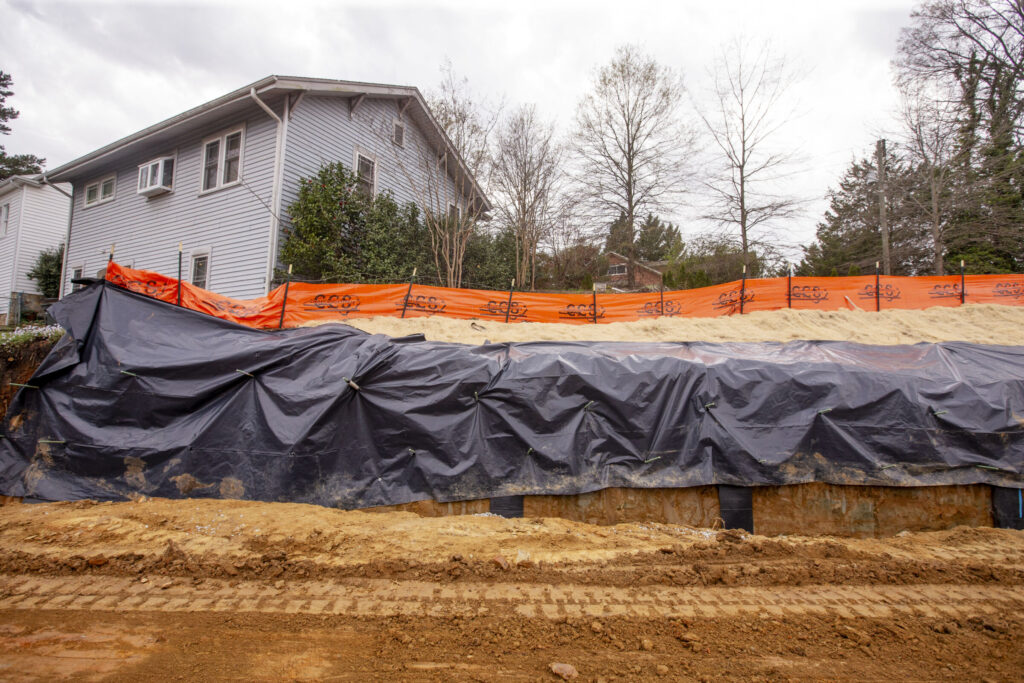
Concrete curbing, connecting sidewalks, and accessibility ramps are in place at various street crossings and intersections along the corridor. Fencing has been added in the northern-most section of the Western Branch, and a small portion of new greenway has been poured in concrete to join with the existing Northern Passage section that previously ended near Prescott Street.


Most notably, initial paving recently started with asphalt now in place between Smith Street and Guilford Avenue. Crews continue to work hard on portions to the south with level grading, gravel application, and surface preparation for further paving in the future.


What is still to come? Lots!
While, yes, good progress has been made, there is still a lot of remaining work to happen before construction is complete. This includes more paving, work under the Friendly Avenue overpass, shoulder treatments throughout the entire corridor, lighting, street crossings, a new traffic signal at W. Market Street, landscaping, debris removal, and more.
What is the latest timeline?
The main construction work is expected to be complete by the end of 2025, while the “finishing touches” will be put in place in early 2026 – such as signage, benches, trash receptacles, bike racks, drinking fountains, public art installation, etc. There has also been additional funding secured privately, to allow for a second phase of landscaping to be added later. As with any major infrastructure project, these construction timelines are always at the mercy of weather, availability of materials, and any other unforeseen delays.


One final reminder that the entire section from Smith Street to Spring Garden Street is an active construction site and closed for public access.